Sign Languages | Booknibs
How Nicaraguan Sign Language Was Born and Why Our Instinct for Grammar Evolves

This nib reveals how a group of isolated children in 1970s Nicaragua achieved what scientists once thought was impossible: the creation of a brand-new language from scratch. You will learn the difference between simple gestures and true grammar, seeing how the human mind acts as a pattern-seeking engine that demands structure. By exploring the shift from "home signs" to a fully functional sign language, you will discover the biological "blueprint" for communication that exists in all of us. This nib offers a rare, front-row seat to a linguistic big bang, proving that language is not just an inherited skill but an unstoppable human instinct that can build bridges out of thin air.
Visual Logic: Mastering the Three-Dimensional Grammar of Sign Language

Discover the "hidden superpower" of sign languages and learn how they break the limits of spoken words. You will explore "depicting signs," a complex system of spatial grammar that acts as a three-dimensional construction kit for ideas. This guide explains how signers use specific hand shapes, locations, and movements to build mental models in the air, allowing them to describe anything from a car chase to subatomic physics with incredible precision. By understanding these linguistic rules, you will see how sign languages offer a unique cognitive advantage, turning communication into a vivid, high-speed exchange of data.
Mapping Space: How Sign Languages Build Meaning Through Visual Structure

Discover how signed languages like ASL turn empty air into a high-definition mental map. You will learn the mechanics of "spatial indexing," a system where signers pin people and ideas to specific physical coordinates to eliminate the confusion of vague pronouns like "he" or "it." This guide explains how directional verbs and "spatial hygiene" allow for faster, more precise communication than spoken English can often manage. By the end, you will understand how the brain uses its natural talent for location-tracking to process complex logic visually, transforming a simple conversation into an organized, three-dimensional database.
More than Just Hands: How Facial Expressions and Body Language Shape American Sign Language

Discover the hidden architecture of American Sign Language (ASL) by looking beyond the hands. This guide reveals how facial expressions and body posture, known as non-manual markers, act as the vital "punctuation" of visual speech. You will learn to identify how a simple eyebrow raise converts a statement into a question and how a shoulder shift can replace complex nouns. By understanding these "visual vocal shifts," you can move past the "hands-only" myth and see how signers use their entire bodies to create logic and nuance. It is an essential read for anyone wanting to appreciate the sophisticated, three-dimensional grammar that gives ASL its soul.
Building on Air: A Guide to Space and Grammar in Sign Language

Discover how sign language transforms empty air into a sophisticated 3D filing system. You will learn the mechanics of spatial referencing, a technique where signers assign specific locations to people or objects to track complex stories with perfect clarity. This guide explains how directional "agreement verbs" bypass the confusion of spoken pronouns, allowing a single movement to replace an entire sentence. By understanding these mental maps and role-shifting techniques, you will gain a fresh perspective on how the human brain organizes information. It is an essential look at the geometric logic that makes visual communication both efficient and cinematic.
The Shape of Language: How Signs Use 3D Space to Build Meaning

This look at the "invisible architecture" of sign languages explores how American and British Sign Languages (ASL and BSL) use three-dimensional space as a sophisticated drafting board for grammar. You will learn how signers "pin" people and objects to specific points in the air to eliminate the confusion of spoken pronouns like "he" or "she." The text also breaks down how signers build topographic maps to describe physical layouts, such as a childhood bedroom, with perfect geometric consistency. By understanding these spatial rules, you will see why sign language is a precise linguistic system rather than simple pantomime. These insights reveal how the human brain can process complex information through sight and geometry just as easily as through sound. Reading this will change how you perceive communication, showing you how empty space can be transformed into a clear, high-definition landscape of meaning.
The Look of Language: Understanding Facial Expressions and Body Movements in ASL

Mastering American Sign Language (ASL) involves much more than just hand shapes. This guide reveals how the face serves as a "control panel" for grammar, transforming simple gestures into complex thoughts. You will learn how shifting your eyebrows can turn a statement into a question and how specific mouth shapes act as adverbs to describe speed or size. By understanding these non-manual markers, you will move past a "robotic" signing style to achieve true fluency. This essential look into ASL mechanics explains why facial expressions are mandatory tools for clear, efficient communication.
Designing Space: How Sign Languages Use Distance and Direction to Build Meaning
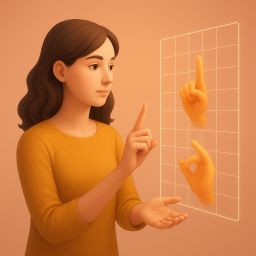
Discover how sign languages replace word order with a sophisticated, three-dimensional grammar called spatial agreement. You will learn how signers use "loci" to park characters in the air, creating a visual database that eliminates the confusion of vague pronouns. This guide explains how directional verbs act as physical bridges, moving between these points to show exactly who did what to whom with incredible speed. By understanding how the body and face add layers of meaning, you will see why signing is a high-speed mental map, not a simple code, offering a masterclass in efficient communication.
More Than Just Hands: How Facial Expressions Act as Grammar in Sign Language

Unlock a new perspective on communication by looking past the hands. In this exploration of sign languages like ASL and BSL, you will discover why facial expressions are actually "biographical keyboards" that function as grammar, rather than just displays of emotion. Learn to distinguish between "emotional" faces and "linguistic" markers, and find out how a simple eyebrow raise or nose scrunch acts as a visual question mark or adverb. You will also see how signers use "multi-channel" transitions to convey complex "if... then" sentences in half the time of spoken English. This guide reveals the sophisticated logic of the human face, transforming how you view the speed and depth of human thought.
More Than Just Hands: How Facial Expressions and Body Language Shape Sign Language Grammar

Mastering a sign language involves much more than just memorizing hand shapes. This guide reveals how the face and body function as a "visual grammar" that adds structure, tone, and meaning to every movement. You will learn how shifting your eyebrows can transform a simple statement into a question, how specific mouth shapes act as descriptive adverbs, and how a head tilt can build complex "if-then" sentences. Understanding these non-manual markers is essential for anyone who wants to move past robotic, word-for-word signing and toward natural, fluent communication. By learning to layer information through both hands and facial expressions, you will discover how sign languages achieve a high-speed efficiency that spoken languages often cannot match. This is an invitation to see the face not just as a mirror for emotion, but as a sophisticated tool for logic and clear storytelling.
Structuring Space and Shape: A Guide to Sign Language Classifiers

Discover the hidden logic of sign languages like ASL and BSL by exploring the "classifier" system. You will learn how signers use specific handshapes as 3D templates to describe an object's size, shape, and movement with more precision than spoken words. This guide clarifies the difference between structured grammar and simple miming, showing how a single handshape can function like a visual pronoun to describe complex actions, such as a car navigating a steep, bumpy hill. By understanding these spatial rules, you will gain a fresh perspective on how the brain processes information. You will see how sign language maps out time and space to communicate intricate details in a fraction of the time it takes to speak them. This is an essential read for anyone interested in linguistics, accessibility, or the remarkable ways humans share ideas through sight and motion.
Hidden Rules of Movement: A Guide to Directional Verbs in American Sign Language

Discover how American Sign Language (ASL) uses the air around a signer as a 3D canvas to build faster, clearer sentences. You will learn to identify "directional verbs," which are sophisticated signs that move through space to show exactly who is doing what without needing separate words for "I" or "you." The text breaks down the "signing space," an invisible stage that prevents pronoun confusion and makes storytelling immersive. By distinguishing these fluid movements from fixed, "plain" verbs, you will gain a practical understanding of how visual grammar turns the atmosphere into a living map of information.
Mapping Space: How the Locus Governs Sign Language Grammar

You will discover how sign languages like ASL and BSL solve the common problem of pronoun confusion - those awkward moments in speech when "he" and "she" become hard to track. By learning the mechanics of "locus" points, you will see how signers map out physical space to create a clear, three-dimensional database in the air. This approach explains how spatial anchors act as visual folders for people and complex ideas, reducing mental effort for the listener. Reading this will change how you view human communication. You will gain a fresh perspective on "agreement verbs" that move between points to show who is doing what, turning a simple conversation into a cinematic experience. This insight reveals that language is not just a linear stream of sound, but a geographic landscape that uses the brain's natural talent for spatial memory to share information with high precision and efficiency.