Sociology | Booknibs
Bunkers and Boltholes: What the Ultra-Wealthy Want in Luxury Survival Real Estate

This nib explores the secretive world of "survivalist real estate," where the global elite are trading digital stocks for deep-earth bunkers. You will learn how modern fortresses are engineered with hydroponic farms and independent power grids to ensure total self-sufficiency. Beyond the floor plans, this nib breaks down the "island mentality" that drives the ultra-wealthy to seek geographic moats in places like New Zealand. By understanding the systemic risks these leaders are hedging against, you will gain a clear look at where they see the world’s social and financial cracks forming. It is a fascinating study of risk, privacy, and the high-stakes insurance policies of the one percent.
Radio Taiso: How American Exercise Programs Became a Japanese Cultural Phenomenon

This nib explores the surprising history and science behind Japan’s most famous morning ritual, its national radio exercise. You will discover how a routine designed for New York life insurance companies in the 1920s became a vital piece of Japanese social glue. The nib explains the concept of muscular bonding, showing how moving in unison releases brain chemicals that build trust and reduce loneliness. You will also learn how small daily habits, or micro-rituals, can unify a workforce and foster a deep sense of community. This nib is essential for anyone interested in how simple physical traditions can strengthen the bonds of an entire nation.
Why Humans Clap: The Science and Secrets of Applause

This nib explores the surprising science behind why we slam our hands together to show love. You will discover the physics of the handclap, from how cupped palms act as air-compressing resonators to the way "acoustic contagion" forces us to join a cheering crowd. The nib explains how applause serves as a biological drum kit for group harmony, helping us bridge the gap between individual minds without using words. By learning to "tune" your own noise and understanding the hidden math of rhythmic clapping, you will see how this primal instinct evolved into a sophisticated tool for social survival and human connection.
The Flat Earth movement: A deep dive into the psychology, sociology, and science of modern conspiracy theories

This nib explores the surprising rise of the modern Flat Earth movement and the psychological forces that drive its followers. You will learn about "Zeteticism," a method that favors personal sensory experience over complex scientific data, and how social media algorithms create digital echo chambers for fringe beliefs. By examining the roots of institutional distrust, this nib reveals why many intelligent people reject proven facts to feel part of an exclusive group. Understanding these perspectives helps you build better critical thinking skills and shows how to navigate a world where a shared sense of truth is increasingly hard to find.
Auroville: Inside the social, economic, and political heart of India’s utopian city

This nib takes you inside Auroville, a real-life town in southern India that has operated for over fifty years without private property, leaders, or a traditional police force. You will learn how "collective stewardship" replaces home ownership and how a closed-loop economy functions using internal credit instead of cash. By exploring the city's galaxy-shaped layout and its consensus-based government, you will discover the practical social engineering required to manage three thousand residents from sixty different nations. This nib reveals why this experimental community is a world leader in eco-construction and offers a provocative look at whether humans can truly thrive through cooperation rather than competition.
Why We Signal Virtue: The Origins and Social Logic of Moral Grandstanding

Why do we feel an urgent need to broadcast our moral outrage online? This book reveals that moral grandstanding is not just a digital nuisance but an evolutionary impulse. You will learn to identify the subconscious tactics used to compete for social status, recognize the biological triggers that make performative anger feel rewarding, and understand why we prioritize group loyalty over objective truth. By mastering these insights, you can navigate divisive social landscapes with greater clarity and intellectual humility. Learn to bypass performative tribalism, choose your battles wisely, and replace the hollow pursuit of likes with authentic, thoughtful integrity.
The Evolutionary Power of Gossip, Why We Share Social Secrets

Gossip is often dismissed as a trivial vice, but it is actually a sophisticated tool for human survival. This book reveals how our impulse to share social information helps us build reliable networks and navigate complex environments. By reading this guide, you will learn to treat social intelligence as a data-driven survival strategy. You will gain the skills to calibrate your internal "reputational map," distinguish between pro-social warnings and malicious rumors, and effectively vet potential partners without relying on costly trial and error. Master these insights to turn your social circles into a reliable resource for security, collaboration, and success.
The Matthew Effect: Why Success Breeds Success in Science and Beyond

Have you ever wondered why credit for a major discovery usually goes to the most famous person in the room rather than the person who did the work? This summary explores the Matthew Effect, a "rich-get-richer" bias that shapes who gets funding, awards, and a place in history. You will learn how "prestige" acts as a mental shortcut that blinds us to new talent, and how the Matilda Effect has historically erased women from scientific breakthroughs. By understanding these social traps, you will discover how to spot true innovation and find out why human progress depends on looking past big names to focus on the work itself.
The Social X-Ray: An Introduction to Critical Theory and the Search for Freedom

This guide introduces you to critical theory, a "social X-ray" that reveals the hidden power structures shaping your daily life. You will move beyond simply observing how the world works to questioning why it functions this way and whom those rules truly benefit. By exploring the history of the Frankfurt School and concepts like the "culture industry," you will learn to spot how media and "common sense" can quietly manipulate your choices. Mastering these tools helps you transform from a passive consumer into a sharp, independent thinker. You will gain the skills to dismantle unfair assumptions and recognize your own power to reshape society. This isn't just an academic exercise; it is a practical roadmap for anyone ready to challenge the status quo and build a freer, more intentional future.
More Than Just Home and Work: Designing the Psychology of a Third Place

Modern life often feels like a lonely commute between the pressures of home and the grind of the office. This insightful guide explores "Third Places" - the coffee shops, parks, and libraries that act as vital social anchors. You will learn how these neutral spaces use "leveling" to strip away social status, allowing you to connect with others as equals regardless of your job or income. The text breaks down the essential ingredients of a perfect community hub, from acoustic "buzz" to layouts that encourage "parallel play." By understanding these design secrets, you will discover how to combat the modern loneliness epidemic and sharpen your social skills. Reading this will change how you view your neighborhood, showing you how these "living rooms of society" act as a necessary safety net for your mental health and happiness.
The Iron Law of Oligarchy: Why Power Always Settles at the Top of Groups and Movements
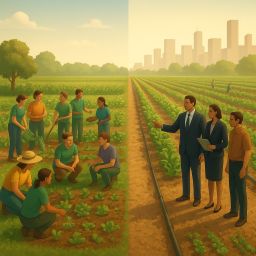
Discover why even the most idealistic groups, from small community gardens to global tech startups, often trade democracy for a "ruling class." This guide breaks down the Iron Law of Oligarchy, a classic theory explaining why power naturally flows to the center as organizations grow. You will learn to identify "goal displacement," where a group’s survival starts to matter more than its mission, and how to spot the information gaps that allow leaders to become indispensable. By understanding these invisible mechanics, you will gain practical tools to resist centralisation. We explore how to use term limits, role rotation, and transparency to keep your organization on track. These insights are essential for anyone who wants to preserve a group's true purpose and ensure the voice of the many is not silenced by the convenience of the few.
How Social Networks and Voter Models Shape Our Thinking: The Geometry of Consensus

This piece explores social physics through the Voter Model, a mathematical lens that reveals why ideas spread like wildfire or stall out. You will learn how the "geometry" of your social circle, not just the logic of an argument, dictates what people believe. The text breaks down why highly connected digital networks make our society prone to sudden, massive flips in opinion, and how a mere 10 percent of committed "zealots" can convert an entire population. By understanding these network structures, you will gain a practical edge in navigating groupthink and recognizing the "tipping points" of cultural shifts. It is an essential look at why the best ideas do not always win and how the architecture of our connections shapes the future.
More Than the Local Pub: The Rise and Power of Digital Third Places

Discover how our "third places"-the essential social hubs outside of home and work-have migrated from local diners to digital platforms like Discord and Reddit. You will learn the specific design traits that make a community feel welcoming, the shift from neighborhood-based friendships to interest-driven bonds, and why these virtual "living rooms" are vital for our mental health. By understanding the rules of digital belonging, you can better navigate online spaces to find a genuine sense of home. This guide explains how to build a niche community from scratch and why "boutique" digital rooms are replacing noisy social media. Whether you are looking for your people or trying to understand the new social landscape, you will gain the tools to turn a screen into a modern sanctuary.
Why the Third Place Matters: Building Connection and Community Outside of Home and Work

Modern life often feels like a lonely shuttle between the "first place" of home and the "second place" of work. This insightful guide introduces you to the "third place" - those vital social anchors like coffee shops, libraries, and parks that bridge the gap. You will learn how to identify these neutral grounds and why "weak ties" - casual acquaintances - are actually more important for your career and mental health than your inner circle. By discovering the magic of "leveling," you will see how these spaces strip away professional stress and social status, fostering genuine human connection. Most importantly, you will gain practical ways to rebuild your social capital and escape digital isolation. Reading this will help you turn your neighborhood into a true community, transforming a hollow routine into a life of belonging.
Beyond the Tribe: How Social Scalability Built the Modern World

Discover how humans evolved from living in tiny, suspicious tribes to building a global civilization of billions. You will learn about "Dunbar’s Number," the biological limit of our social brains, and how we use tools like money and law to bypass it. This text explains why modern life feels so impersonal and how "social scalability" allows us to work with people we have never met. By the end, you will understand how to shift trust from individuals to predictable systems. This knowledge helps you navigate the "invisible architecture" of the world, from old-fashioned contracts to the digital code that powers the internet. It is an essential look at how we trade intimacy for the power to change the world.
The Power of Casual Connections: Why Acquaintances are the Real Key to Innovation and Opportunity

Your closest friends provide emotional support, but they rarely offer new opportunities. Because they move in the same circles as you, they often lack the "fresh" information you need to grow. This insightful guide explores why casual acquaintances - your "weak ties" - are actually your's most valuable assets for career breakthroughs and creative thinking. You will learn how to identify "bridge" connections that link you to different industries, how to use "social capital" to solve complex problems, and how to revive dormant relationships without feeling awkward. By understanding the science of social networks, you can step out of your echo chamber and build a more resilient, well-connected life.
The Lindau Effect: How Online Subcultures Speak in Code

By reading this guide, you will master the "Lindau Effect," the social phenomenon that uses cryptic slang as a digital secret handshake. You will learn how niche groups use jargon as a security system to verify expertise and build trust in anonymous spaces. Discover how to identify these "proof of work" terms to avoid looking like an outsider or a "tourist" in new professional circles. More importantly, you will gain the skill of code-switching, which is the ability to speak like a specialized insider while remaining understood by the general public. This knowledge helps you bypass social barriers, avoid echo chambers, and build bridges across any online community.