Mathematics | Booknibs
The Mathematical Legacy of Srinivasa Ramanujan: Partnering with G.H. Hardy and How Intuition Shaped Modern Science

This nib tells the gripping story of the unlikely partnership between G.H. Hardy, a refined Cambridge professor, and Srinivasa Ramanujan, a self-taught clerk from India. By reading this nib, you will discover how to identify "hidden" talent that does not fit traditional molds and why institutional gatekeeping often overlooks the world’s best ideas. You will also learn about the "taxicab number" and the groundbreaking math behind partitions- - the ways we break down whole numbers - which now helps modern scientists understand black holes and string theory. Ultimately, this nib explores the logic of taking risks on outsiders, showing you how to bridge the gap between strict rules and raw, creative intuition to solve impossible problems.
Claude Shannon and the Birth of Information Theory: From the First Bit to the Digital Revolution
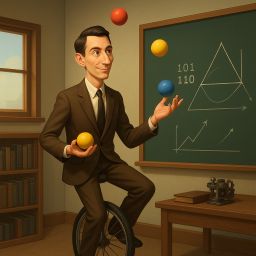
This nib explores the mind of Claude Shannon, the eccentric genius who invented the digital age while riding a unicycle through Bell Labs. You will learn how Shannon transformed abstract ideas into "bits," the universal language that powers every text and video call today. The nib explains how to measure uncertainty using entropy and reveals the mathematical trick that allows clear data to travel through noisy, glitchy connections without errors. By understanding these blueprints, you will see how Shannon’s work defines the speed limits of the internet and provides the logic behind modern artificial intelligence. It is an essential look at the man who proved that even the most complex information can be stripped down to a simple choice between zero and one.
Plimpton 322: Babylonian tablets and the ancient roots of trigonometry and Pythagorean triples

This nib reveals how an ancient clay tablet, once dismissed as a routine school exercise, upended the history of mathematics. You will discover how Babylonian scribes mastered complex geometry over a thousand years before Pythagoras was even born. The nib explains the ingenious "base 60" system that still governs how we measure time and circles today, showing why it was actually more precise than our modern decimal system. By exploring theories on whether this tablet was a teacher's answer key or an architectural blueprint, you will see how ancient experts solved sophisticated engineering problems without modern tools. This is a fascinating look at a forgotten peak of human brilliance that challenges everything we thought we knew about the origins of science.
The Braess Paradox: Why Adding Lanes Can Lead to Worse Traffic jams

This nib explores why adding more capacity to a network often creates more congestion than it solves. By following the story of a major highway removal in Seoul, you will learn about Braess’s Paradox, a counterintuitive mathematical principle that explains why new roads can actually slow down city traffic. You will discover how individual, selfish choices lead to a "Price of Anarchy" that clogs up systems, and how this same glitch affects power grids, the internet, and even nature. It is a vital lesson in network theory that will change how you view urban planning and show you why sometimes, the best way to speed things up is to take a road away.
The Basics of Information Theory, Hamming Distance, and How Error-Correcting Codes Evolved
This nib explores the invisible math that keeps our digital world from crumbling into static. You will discover how pioneers like Claude Shannon and Richard Hamming moved beyond "turning up the volume" to invent messages that can actually heal themselves. By learning about Hamming Distance and the algebra behind QR codes, you will understand how we beam clear photos from deep space and play scratched discs without a skip. This nib reveals why digital data is surprisingly fragile and how clever redundancy acts as a safety net, ensuring your Wi-Fi and hard drives stay reliable despite the constant noise of the universe.
Better Kidney Transplants Using Graph Theory and Game Theory Algorithms

This nib examines how Algorithmic Game Theory transforms kidney transplantation from biological dead ends into solvable, life-saving networks. You will learn how mathematicians represent donor-patient pairs as nodes in a graph, how they build cycles to bypass incompatibility, and why altruistic donors create chains that extend the reach of every gift. By exploring these logistics, you will understand how to encode human values - like fairness and equity - directly into optimization software. This perspective matters because it allows us to overcome the limitations of human biology, proving that complex, life-or-death challenges can be resolved through the power of elegant, logical systems.
The Mathematics of Girih Tiles: Islamic Geometric Art and the Discovery of Aperiodic Quasicrystals

Discover the mathematical genius behind Iran’s 15th-century Darb-i Imam shrine. While long dismissed as mere decoration, these intricate tile patterns represent a sophisticated system of geometry that predates Western discoveries by centuries. By reading this, you will learn to identify the five modular "Girih" shapes, understand the difference between repeating patterns and aperiodic structures, and see how medieval artisans "coded" complex, infinite designs without modern computers. This exploration bridges the gap between historical artistry and modern quantum physics, offering a fresh perspective on how simple, rule-based systems can generate the profound beauty hidden within complex, chaotic environments.
The Birthday Paradox: Why our brains struggle to understand logic and odds

You will discover why your intuition often fails when it comes to probability and how to spot the "math of connections" in your daily life. This guide explains the Birthday Paradox, a surprising phenomenon where only 23 people are needed to make a shared birthday more likely than not. You will learn how to calculate the odds of rare events by looking at the connections between people rather than the individuals themselves. Beyond simple party tricks, these principles show how digital security experts prevent hackers from creating "collisions" to faking secure data. You will also gain practical insights into the "Complexity Tax," which explains why communication breaks down as teams grow. By mastering this shift in perspective, you can better manage social networks, understand cybersecurity, and predict the hidden risks in any growing system.
The Braess Paradox: Why building more roads can lead to worse traffic jams

Discover why building new roads often creates more traffic rather than fixing it. This guide breaks down the Braess Paradox, a fascinating quirk of game theory that shows how adding shortcuts can actually increase travel times for everyone. You will learn to identify "traffic traps" where individual selfishness leads to a group mess, and see how cities like New York and Seoul improved flow by removing major streets. Understanding these complex systems is essential for anyone interested in urban planning, logic, or simply surviving the morning commute. By the end, you will look at a city map not as a grid of pipes, but as a living network where less is often more.
The Birthday Paradox and the Mathematics of Coincidence: Why Miracles Happen More Often Than You Think

Human intuition is notoriously bad at math, often leading us to mistake simple probability for fate. This guide deconstructs the "Birthday Paradox" to show why a shared birthday in a small crowd is actually a mathematical near-certainty rather than a miracle. You will learn how to calculate the power of pairings, why "one-in-a-million" events happen thousands of times a day, and how to spot confirmation bias in your own life. By shifting from a self-centered view to a statistical one, you will gain a sharper "BS detector" for coincidences and a more grounded, logical perspective on how the world truly works.
Ramsey Theory: Finding the Certainty of Order within Chaos
Discover how Ramsey Theory proves that complete disorder is impossible. This guide breaks down why patterns inevitably emerge in everything from star clusters to stock markets once a system grows large enough. You will learn the logic of the Pigeonhole Principle to understand how constraints force structure out of chaos, and you will explore the "Theorem on Friends and Strangers" to see why certain social connections are mathematical certainties. By the end, you will be able to distinguish between meaningful data and "mathematical ghosts," giving you a sharper, more skeptical lens for navigating our world of Big Data.
Spotting the Math of Deception: A Guide to Benford's Law and Data Forensics
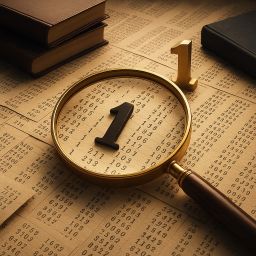
Discover the hidden mathematical signature that governs everything from stock market fluctuations to city populations. This guide introduces you to Benford's Law, a counterintuitive phenomenon where the number one appearing as a leading digit is nearly seven times more likely than the number nine. By reading this, you will learn how to identify "red flags" in massive datasets and understand the "scale invariance" that makes this rule work across any unit of measurement. You will gain a practical "fraud hunter's" toolkit to spot fabricated data in financial records or scientific studies. Understanding why humans are naturally bad at faking randomness helps you protect your business and sharpen your skepticism. Mastering this mathematical pulse allows you to detect deception in seconds, giving you a professional edge in an era of digital misinformation.
Secrets of the First Digit: How Benford’s Law Reveals Hidden Mathematical Patterns
Discover how a bizarre mathematical pattern called Benford’s Law governs everything from river lengths to stock prices. In this guide, you will learn to spot the "hidden fingerprint" that proves whether a set of data is natural or a human-made fake. You will gain a practical edge by learning how to apply this rule to catch financial fraud and audit complex spreadsheets, where a simple count of leading digits acts as a "smoke detector" for deception. By understanding how "orders of magnitude" work, you will see why the number 1 appears far more often than 9 in the real world. This mental model will sharpen your intuition about growth and probability, helping you distinguish between random labels and meaningful measurements. Whether you are curious about deep patterns in nature or looking for professional tools to verify data integrity, this exploration reveals the predictable structure hidden within a messy world.
The Hidden Pattern: Understanding Benford's Law and the Science of First Digits
You might assume the numbers in our world appear at random, but nature follows a hidden script. This guide introduces you to Benford-s Law, a mathematical phenomenon where the digit 1 appears as the leading number far more often than any other. By exploring how this pattern governs everything from file sizes to river lengths, you will learn to spot the underlying structure of growth. You will gain three practical skills: identifying which datasets follow this law, using digit distribution to flag potential financial fraud, and understanding why human intuition fails at faking randomness. These insights turn simple data into a powerful tool for detecting lies in tax returns or election results. Whether you are a curious observer or a budding investigator, this read will change how you look at the numbers on your screen and the world around you.