Technology & Digital Skills | Booknibs
Technology & Digital Skills
Explore focused learning nibs in Technology & Digital Skills on Booknibs.
Powering the Deep: The Engineering of Undersea Fiber Optic Cables

Discover how humanity powers the internet across the vast, dark ocean floor. While we perceive the internet as a wireless cloud, the reality is a fragile, colossal physical infrastructure held together by high-voltage cables. You will learn the mechanical secrets of deep-sea repeaters, explore the ingenious constant-current power physics, and understand the mind-bending concept of using the ocean as a giant electrical grounding system. This exploration demystifies the invisible systems sustaining global connectivity, revealing how engineers maintain a continuous electrical circuit thousands of miles long where manual maintenance is impossible.
The Satoshi Nakamoto Cipher: Inside the Origins of Bitcoin and the Birth of Blockchain Technology

This nib uncovers the mystery of Satoshi Nakamoto, the anonymous creator who launched Bitcoin during the 2008 financial crisis and sparked a global revolution. You will trace the digital breadcrumbs left behind, from British speech patterns to unique "old school" coding styles, to see how investigators identify potential suspects. By exploring the legacy of the Cypherpunks, you will understand how Bitcoin solved the "double-spend" problem using Proof of Work, a system that secures money through math rather than banks. This nib explains why Nakamoto’s choice to remain a ghost was a stroke of genius that kept the network neutral and leaderless. You will walk away with a clear grasp of how decentralized trust works and why the world’s most famous inventor chose to leave billions of dollars untouched to protect his vision.
BGP Hijacking: Fixing Internet Routing Flaws with RPKI Security

This nib reveals the hidden fragility of the internet, which still relies on a "handshake" protocol sketched on three napkins in 1989. You will learn how the Border Gateway Protocol (BGP) acts as the internet's air traffic control and why its lack of built-in verification allows a single mistake or a state-sponsored lie to reroute 15% of global traffic in minutes. By examining high-stakes events like the 2008 YouTube blackout and the 2010 China Telecom incident, this nib explains how digital "maps" are easily manipulated. Understanding these vulnerabilities is essential for grasping modern cybersecurity, as you discover why the world is finally racing to replace blind trust with digital proof to stop high-speed heists and global data leaks.
The Microchip Revolution: How the Integrated Circuit Conquered the Tyranny of Numbers

This nib reveals how a lonely summer in a Texas lab and a "wrong" idea birthed the digital age. You will learn how Jack Kilby and Robert Noyce overcame the "Tyranny of Numbers," the physical limit that once made complex computers impossible to build. By exploring why experts mocked the first microchip as a waste of expensive materials, you will gain a new perspective on why "useful ignorance" often beats deep expertise when solving impossible problems. This nib shows how shifting from hand-soldering parts to "growing" them inside stones changed the math of our economy, turning the once-costly transistor into the most abundant resource on earth.
Building Tougher Rural Networks: Inside the DIY Community Web of Sardinia

Discover how a resourceful community of shepherds and locals built a self-healing internet deep in the rugged mountains of Sardinia. This nib explores the mechanics of mesh networks, where every user acts as a relay point to eliminate dead zones without relying on big corporations. You will learn the logic of antifragile design - systems that actually get stronger under pressure - and see how the BATMAN protocol allows devices to route data independently using a digital immune system. By understanding this low-power, solar-run model, you will gain practical insights into building resilient, decentralized tools that thrive in the harshest environments.
Mastering Computer Science and Hardware Architecture without Tools: Assembly Language Programming under Extreme Constraints

This nib follows the incredible journey of Will, a man who taught himself the most complex level of computer science while serving time in a high-security Texas prison. You will see how he salvaged components from broken televisions to build a functioning computer, using nothing but logic, trash, and sheer persistence. Through his story, you will master the four pillars of computer architecture and learn how to "think like silicon" by simulating calculations on paper. This nib demonstrates that deep expertise does not require expensive tools or the internet; it simply requires the discipline to master the core principles underneath the screen. This is a powerful lesson in how extreme constraints can actually sharpen your mind and turn you into a superior problem solver.
How High-Frequency Traders Use Microwave Links and Line-of-Sight Networks to Cut Latency in Arbitrage

This nib explores the secret, high-stakes world of microwave trading, where private firms spend millions to shave milliseconds off data speeds. You will learn why air is a more efficient medium than fiber-optic glass and how the physics of light creates an absolute speed limit for global markets. The nib details the engineering feats required to build straight-line networks across rural landscapes and explains how "latency arbitrage" allows traders to effectively see into the future. By the end, you will understand how the invisible laws of geography and weather still dictate the flow of the modern digital economy.
How Root Key Ceremonies protect the Internet and the Domain Name System

You will discover how a small group of people meets in secret high-security rooms to prevent the entire internet from being hijacked. This nib explains the hidden mechanics of the Domain Name System (DNS), the digital phonebook that connects web names to the correct addresses. You will learn how "multi-person control" works to stop hackers from redirecting your bank logins to fake sites, and why the world still relies on physical metal keys and hand-scanners instead of just code. By exploring this quarterly ritual, you will see why true digital security actually depends on human witnesses and international cooperation to keep the global web trustworthy.
How Harry Beck’s innovation revolutionized the London Underground with topological mapmaking

Discover how a persistent draftsman turned a chaotic "spaghetti bowl" of tracks into the iconic London Underground map. This nib explores the vital shift from geographic accuracy to topological design, showing you how Harry Beck used electrical circuit logic to simplify complex systems. You will learn the difference between physical distance and connectivity, the psychological trick of reducing "cognitive load" to prevent information overload, and why the most effective interface often requires stripping away the truth to highlight the journey. It is a masterclass in user-focused design that will change how you organize information and solve problems in any field.
How BGP and Internet Routing Systems Caused the 2021 Meta Global Outage

Discover how a routine maintenance error at Meta once wiped three of the world’s biggest social networks off the map. This nib explores the "three-napkin protocol" known as BGP, the invisible gossip system that directs all global internet traffic. You will learn how the internet heals itself after physical disasters, why it remains terrifyingly vulnerable to simple typos, and why engineers occasionally need power tools to fix digital glitches. By understanding the trade-off between absolute security and global freedom, you will see why the modern web is less of a rigid machine and more of a fragile, living conversation based on trust.
How Capacitive Touchscreens Work: The Physics and Engineering of Modern Smartphone Displays

Discover how your body acts as a biological battery to power the modern world. This nib explains the physics behind your smartphone screen, showing how you use the salty water in your cells to "steal" electricity from an invisible grid of indium tin oxide. You will learn why ordinary gloves leave you digitally invisible and how your phone distinguishes a human thumb from a raindrop. By understanding capacitance, or the storage of electric fields, you will master the science of your own touch. This nib reveals the hidden engineering that turns your physical presence into a digital command, transforming every swipe into a high-tech spark.
Getting Started with Meilisearch: Exploring Inverted Indexes, Ranking Rules, and Hybrid Search Registration

This nib introduces you to Meilisearch, a fast, open-source engine designed to bring psychic-speed search to any application. You will learn how the inverted index and prefix matching enable results to appear instantly with every keystroke, even if the user makes a typo. The nib explains the logic behind ranking rules like proximity and exactness, which ensure the most relevant results always sit at the top of the list. You will also explore modern hybrid search, which combines traditional keyword matching with AI-powered semantic search to understand the meaning behind a query. By the end, you will know how to use these tools to build a polished, professional search experience that handles millions of records on modest hardware.
The Ripple Effect: How a Seven-Day Global Internet Blackout Would Unravel Infrastructure and Society

This nib explores the terrifying fragility of our modern world by tracing the domino effect of a week-long global internet outage. You will discover how "basement protocols" like DNS and BGP act as the invisible glue holding society together, and why their failure would trigger a total collapse of food supplies and power grids within days. By moving past the loss of social media to examine the breakdown of "just-in-time" logistics and hospital care, this nib reveals why our digital infrastructure is a vital utility rather than a luxury. It is an essential look at how we have outsourced our collective memory and survival to a network of cables, offering a practical perspective on why digital resilience is the greatest challenge of our time.
How transistors work and how they built the world of modern computing and microelectronics

This nib traces the evolution of the transistor, the tiny switch that powers every device in your pocket. You will learn how engineers moved beyond bulky, hot vacuum tubes to harness the "solid state," using crystals to control electricity with perfect precision. By exploring the chemistry of semiconductors and the logic of binary code, the nib explains how we shrank room-sized computers into microscopic circuits. This history matters because it reveals the hidden physics behind your smartphone, showing how mastering matter at the atomic level sparked the modern digital revolution.
Understanding Wi-Fi: How signals, radio bands, and communication protocols work

This nib reveals the invisible physics and clever social rules that allow wireless internet to function in a crowded world. You will learn how devices use a strict "party etiquette" to take turns speaking without interrupting each other, ensuring your data does not turn into useless noise. The nib explains the practical trade-offs between 2.4 GHz and 5 GHz frequencies, helping you understand why your connection might drop near a microwave or a fish tank. By exploring how routers use multiple antennas to bounce signals off walls and target your phone, you will gain a clear sense of how to optimize your home network for better speed and reliability.
How Email Works: A Guide to SMTP, DNS, and the Backbone of Digital Messaging

This nib reveals the invisible mechanics behind every "send" button, tracing the split-second journey of a message across the global web. You will learn how the SMTP handshake allows two nervous servers to trust each other and how MX records act as a digital GPS to find the right destination. The nib also breaks down the "Trinity of Deliverability" - SPF, DKIM, and DMARC - to show how modern filters catch scammers before they reach your inbox. By understanding these 40-year-old pillars, you will grasp why email remains the world’s most resilient, decentralized tool for communication while modern apps remain locked behind corporate walls.
The Birth of Human Factors Engineering and the Design Principles of Alphonse Chapanis

This nib explores the birth of human factors engineering, a field that stopped blaming "pilot error" and started fixing flawed design. You will learn how psychologist Alphonse Chapanis used simple wooden shapes to prevent deadly B-17 bomber crashes, proving that machines should adapt to the human mind, not the other way around. By understanding concepts like shape coding and forcing functions, you will discover why your phone, your car, and even your kitchen stove work the way they do. This nib is essential for anyone interested in why "user-friendly" products succeed and how empathetic design saves lives by working with our natural instincts rather than fighting them.
How Radia Perlman Fixed Broadcast Storms with the Spanning Tree Protocol

This nib explores the critical invention of the Spanning Tree Protocol, the elegant solution that saved early networks from collapsing under "broadcast storms." By reading this, you will learn how local networks organize themselves, why redundant paths cause infinite data loops, and how a simple "tree-based" logic allows modern systems to heal themselves automatically. These insights matter because they reveal how "plug and play" infrastructure relies on silent, self-correcting math to prevent human error from shutting down our digital world. This nib is worth reading to grasp how the most robust technology often comes from prioritizing simple, logical design under pressure.
The Origins and Mechanics of Packet Switching: How Cold War Research Built the Internet

Discover how Cold War paranoia sparked the digital age in this nib. By exploring the evolution of "packet switching," you will learn the core logic behind the internet, how computers manage distributed networks, and why resilience often requires breaking information into fragments. This nib explains how these pioneers turned a massive technical limitation into the foundation of modern global communication. You will gain a practical understanding of how data fragments traverse the world to reach your screen, helping you appreciate the robust, decentralized design that keeps our digital infrastructure reliable even when individual components fail.
The Physics of Modern Chips, Global Supply Chains, and the Economic Feedback Loop
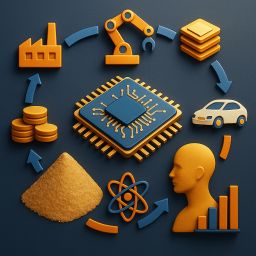
This nib reveals how a tiny grain of silicon becomes the brains behind our modern world. You will learn the mechanics of the "Yield Loop," the strategic risks of global supply chain concentration, and how industry-wide feedback loops trigger massive market swings. By exploring the fragile precision required for high-tech manufacturing, this nib dismantles the misconception that these processes are automated and simple. Understanding these hidden, interconnected systems is essential for grasping why global shortages occur and why the future of technology rests on such a delicate, geographically sparse web of specialized talent, resources, and extreme engineering.